In the dry country of Shekhawati, where the Thar desert meets the broken ridges of the Aravalli, grandmothers have told the same story for centuries. It begins not with a goddess but with a little girl — a daughter of a Chauhan household, remembered in the songs as Jeevan Bai, or simply Jeen. Folk tradition commonly places her birth in the Churu region, in a village of the Shekhawati plains. Her mother died while she was very young, and it was her elder brother Harsh who raised her with a love that the songs describe as greater than a parent’s.
1. The water pots at the well
Years passed and Harsh married. The new bride and the young sister-in-law lived together, and like many such pairs in folk stories, they teased one another about whom Harsh loved more. One morning, carrying brass pots of water on their heads back from the village well, they agreed on a test: whichever pot Harsh lifted down first would prove whom he loved the most.
Harsh knew nothing of the wager. Seeing both women arrive, he went first to his wife and lifted her pot. It was a small, ordinary act — but to Jeen it felt like the end of the world she had known. The songs say she set her own pot down without a word and turned towards the hills.
“भाई ने पहले भाभी की ही, गागर दई उतार”Her brother lifted his wife’s pot first — and Jeevan’s heart was broken.
— from the bhajan Harsh Bhai Ki Laadli
2. Into the Aravalli: the penance
Jeen walked south-east into the rocky Aravalli range and climbed to a lonely peak, remembered in folk songs as Kajal Shikhar. There she gave up food, comfort and every tie to her old life, and sat in tapasya — deep, disciplined penance. The bhajans picture her with stone as her bed and the wind as her lullaby. In Indian devotional thought, such austerity transforms a person: the narrow pain of the self is burned away, and what remains is pure power, or shakti.
3. Harsh follows — and becomes Harshnath
Realising what had happened, Harsh hurried after his sister. He found her deep in meditation and fell at her feet, weeping and begging her to come home. But Jeen had gone too far into her penance to return. She answered him gently: she was no longer only his sister, but now belonged to the whole world as its Mother.
Unable to leave her and unable to bring her back, Harsh too renounced the world and sat in penance on a neighbouring hill. That hill — Harsh Parvat, near Sikar — carries his name to this day, and the ancient Harshnath temple there is associated with his memory; in many tellings he is worshipped as a form of Bhairav, the guardian of the Mother. Devotees therefore often visit both shrines, honouring the brother and sister together.
4. Bhanwron Wali — the miracle of the bees
The most famous leela of Jeen Mata belongs to the Mughal period. Legend says that an imperial army — most tellings name the emperor Aurangzeb, whose campaigns against temples are remembered across North India — marched on the shrine at Rewasa to destroy it. The priests and villagers had no army of their own. They prayed.
As the soldiers advanced, the story goes, vast swarms of bees (bhanwre) poured out of the hills and fell upon them. Horses bolted, elephants panicked and the army scattered. The humbled emperor is said to have asked the goddess’s forgiveness and arranged for oil to be sent for the temple’s eternal lamp. This is why devotees lovingly call her “Bhanwron Wali Mata” — the Mother of the bees — and why the bee appears again and again in her bhajans.
“माँ ने भेजी भँवरों की सेना, गूँजी चारों ओर”The Mother sent an army of bees, humming in every direction.
— from the bhajan Bhanwron Wali Maat Meri
5. The akhand jyot
Linked to the bee legend is the akhand jyot, the unbroken flame of the sanctum. Devotees speak of it with great reverence as a light that has been kept burning for generations, and lighting a home jyot during Navratri is understood as bringing a spark of the Rewasa flame into one’s own house. The bhajan Akhand Jot Jale Darbar is devoted entirely to it.
6. The temple in history
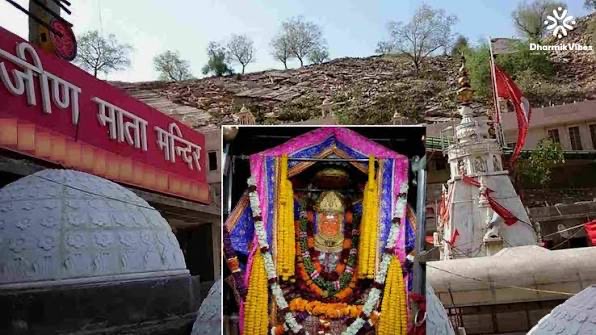
Beyond legend, the shrine at Rewasa is genuinely ancient. Historians of Rajasthan generally date the temple’s earliest structural phases and inscriptions to the era of the early medieval Chauhan rulers of the region, around the 10th–11th centuries CE — the same broad period as the celebrated ruins of the Harshnath temple on the nearby hill. Over the following centuries, rulers, merchant families and ordinary devotees repeatedly repaired, extended and decorated the complex. The result today is a living temple where old stone sits alongside new marble, silver-plated doors and a tall white shikhar visible from far down the valley.
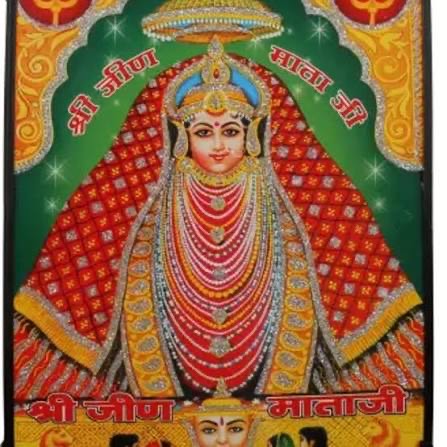
The deity in the sanctum is worshipped as an eight-armed form of the Mother, associated with Durga as slayer of Mahishasura. Her face is covered in sindoor and she is dressed daily in silks and garlands, so that devotees mostly see the radiant face and the rich shringar rather than the stone form beneath.
7. The longest folk song of Rajasthan
Jeen Mata’s story has been carried less by books than by singers. Wandering jogi bards traditionally sang her ballad — the Jeen Mata ka geet — through whole nights, accompanied by simple string and percussion instruments. Rajasthani folklore studies and state general-knowledge texts commonly describe it as one of the longest folk songs of Rajasthan. Its verses wander through Jeen’s childhood, the quarrel at the well, the penance, Harsh’s grief and the miracles, with each singer adding local colour. The bhajans in our Bhajan Sangrah stand in this same living tradition.
8. Kuldevi of many families
Across Shekhawati and among Rajasthani communities spread throughout India, Jeen Mata is honoured as kuldevi — the family goddess who watches over a lineage. Families come to her for every milestone: a newborn’s jaat-jadoola (first haircut), a wedding, a new house or business. Newlywed couples traditionally visit to take her blessing before beginning their life together. This is why so many of her bhajans are sung by women and are full of chunari, bangles and family blessings — she is woven into the life of the household itself.